

Möchten Sie eine E-Mail-Adresse bei @ingenieros.es?
Registrieren Sie sich in unserer Jobbörse und beantragen Sie Ihr kostenloses E-Mail-Konto @ingenieros.es für die private oder berufliche Nutzung.








Wichtige Nachrichten




Die Forschungsgruppe Bauingenieurwesen der Universität Burgos patentiert hat zwei neue Baumaterialien, Gipse, denen Polymerrückstände aus verschiedenen Industriezweigen zugesetzt werden. Insbesondere wurde ein Gips mit rezykliertem Polyamidpulver und einem gemilderten Gips entwickelt, in dem steife Polyurethanschaum, beide Materialien, die die Wärmeisolierungseigenschaften verbessern, enthalten sind.
Wie DiCYT, die Forscherin Veronica Calderón, erklärt, handelt es sich um Polymerabfälle aus verschiedenen Branchen, die zur Herstellung eines neuen Produkts genutzt werden. Zunächst untersuchen die Forscher den Polymerrückstand, untersuchen ihre Korngröße und ihre chemische Zusammensetzung und prüfen, ob er mit dem Gips vereinbar ist.
Anschließend vermischen sie Gips, Wasser und verschiedene Gipsersatzstoffe durch das Polymerpulver und erhalten "leichtere Materialien, die viel mehr wärmeisolieren," während sie "die Schallisolierung aufrecht erhalten." Mit diesem Material hat die Forschergruppe Laminatplatten hergestellt und in die Arbeit gestellt, Platten, die derzeit "eine sehr gute Haltbarkeit" zu haben scheinen.
Die Forscher, die seit 2009 an dieser Linie arbeiten, patentieren auf der einen Seite Bau-Pips aus hydratisiertem Calciumsulfat mit verschiedenen Gipsersatzstoffen durch recyceltes Polyamidpulver. Polyamid ist ein komplexes Recyclingpolymer, was hohe Kosten verursacht und häufig auf einer Deponie ohne größeren Einsatz landet. Die Verwendung als Baumaterial stellt daher eine Alternative dar, die "viele positive Aspekte wie eine geringere Dichte des Materials aufweist, die die Inbetriebnahme und den Transport zu diesem Material erleichtert, sowie bessere Wärme- und Schallisolierungseigenschaften."
Darüber hinaus haben sie patentiert leichten Gips, der Industrieabfälle aus starren Polyurethanschaum enthält. Schaumige polymerische Abfälle werden nach dem Mahlen mit dem Gips je nach Verwendung in unterschiedliche Korngrößen gemischt. Schaumglasur, wie die Forscher erinnern, wird unabhängig als Isolierstoff im Bausektor verwendet, so dass Mischstoff mit Gips mit anderen traditionellen Produkten konkurrieren könnte.
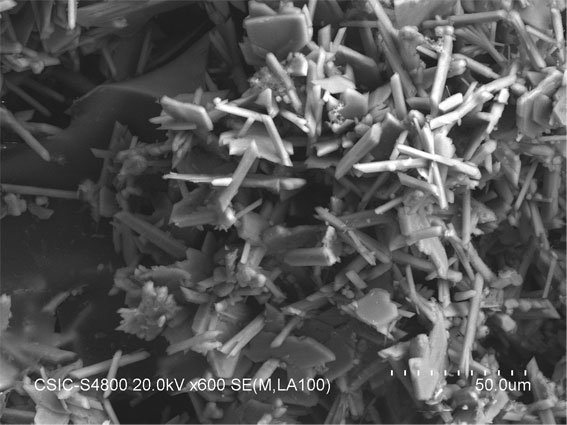
Mikrostruktur eines der Gips-basierten Materialien gemischt mit polymerischen Abfällen (FOTO: Forschungsgruppe für Bauingenieurwesen).
Construmat 2013
Konkret wurde dieses Gipsmaterial und Polyurethanschaum heute im Innovation Center der Construmat Messe 2013 in Barcelona präsentiert. Die Forschungsgruppe "Bauingenieurwesen" der Universität Burgos war eines der 12 Technologiezentren und Universitäten in der ganzen Welt, die für die Präsentation ihrer Forschungsarbeiten auf dem Gebiet der neuen Materialien mit Polymerabfällen ausgewählt wurden.
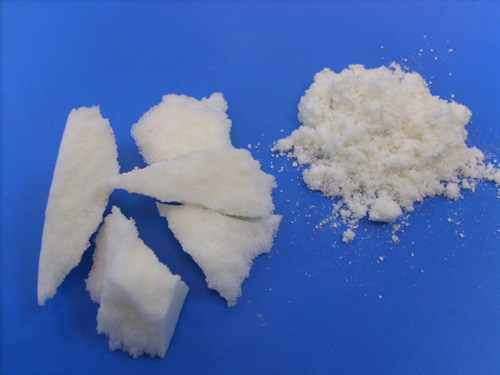
Polyurethanschaum (FOTO: Cartif).
Bibliographische Angaben
S. Gutiérrez-González, M. Alonso, J. Gadea, A. Rodríguez, V. Calderón. Rheological behaviour of gypsum plaster with polyamide powder wastes. Construction and Building Materials. Vol.38. 407-412. 2013
S. Gutiérrez-González, J. Gadea, A. Rodríguez, M T Blanco-Varela, V. Calderón. Compatibility between gypsum and polyamide powder waste to produce lightweight plaster with enhanced thermal properties. Construction and Building Materials 2012, 34, 179–185.
S. Gutiérrez-González, J. Gadea, A. Rodríguez, C. Junco, V. Calderón. Lightweight plaster materials with enhanced thermal properties made with polyurethane foam wastes. Construction and Building Materials 2012, 28, 653–658.
_____________________________
Cristina G. Pedraz/DICYT
Quelle
Weitere Branchennachrichten
La Universidad de Castilla-La Mancha ha acogido los días 7 y 8 de octubre una reunión de coordinación de FIREFLY, un proyecto europeo que busca electrificar parte de la cadena de valor de la industria química y reducir su dependencia de los recursos fósiles. El encuentro se celebró en la Facultad de Ciencias y Tecnologías Químicas de Ciudad Real. El...
Weitere Informationen
La Escuela Técnica Superior de Ingeniería Industrial de Barcelona, perteneciente a la Universitat Politècnica de Catalunya, celebra sus 175 años con una exposición que conecta su historia con los desafíos tecnológicos y sociales de las nuevas generaciones de ingenieros. La muestra, inaugurada el 8 de octubre, puede visitarse hasta el 17 de octubre en CASA SEAT, en Barcelona, con entrada...
Weitere Informationen
La Universidad Pontificia Comillas ha reunido a representantes institucionales, académicos y especialistas del sector tecnológico y de defensa para analizar las oportunidades y los desafíos de la inteligencia artificial en la seguridad y la defensa de España. El seminario, celebrado el 7 de octubre y difundido por la Universidad el día 9, fue organizado por la Facultad de Derecho de...
Weitere Informationen
La Universidad Politécnica de Madrid dedica este 9 de octubre una jornada a los retos de integrar el hidrógeno en la industria y el transporte, dos ámbitos en los que la reducción de emisiones exige combinar diferentes soluciones tecnológicas. La Comunidad del Hidrógeno y Pilas de Combustible de la UPM organiza el encuentro en el salón de actos de la...
Weitere Informationen
La ingeniera de telecomunicación Alicia Ramón Catalán es la ganadora del Premio Pioneras_IT 2026, promovido por el Colegio Oficial de Ingenieros de Telecomunicación y la Asociación Española de Ingenieros de Telecomunicación para visibilizar el talento femenino en el sector. La elección, anunciada el 28 de septiembre, culmina una convocatoria cuyo acto de entrega se programó para el 8 de octubre...
Weitere Informationen