


Möchten Sie eine E-Mail-Adresse bei @ingenieros.es?
Registrieren Sie sich in unserer Jobbörse und beantragen Sie Ihr kostenloses E-Mail-Konto @ingenieros.es für die private oder berufliche Nutzung.







Wichtige Nachrichten




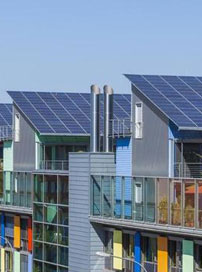
Die Sonne ist eine unerschöpfliche Energiequelle, die viele der gegenwärtigen Energieprobleme lösen könnte. Das Gerät, das die Umwandlung von Sonnenlicht in Elektrizität durchführen kann, ist die Photovoltaikzelle, die allgemein als Solarzelle bekannt ist.
Es gibt jedoch eine Reihe von Hindernissen, die eine breitere Nutzung der Daten verhindern, u. a. durch relativ hohe Kosten (in der Größenordnung von 20 Cent je produziertem Watt) und Niedrige Effizienz, unter 17%. Das heißt, von jedem Watt, den wir von der Sonne erhalten, nutzen wir nur einen kleinen Teil: die 0,17 Watt, die dem sichtbaren Spektrum entsprechen.
Der Grund für die geringe Effizienz konventioneller Photovoltaikzellen liegt darin, dass die Ausgangsmaterialien für ihre Herstellung, wie z. B. Silicium, können nur einen kleinen Teil des Sonnenspektrums absorbieren und nutzen. Der Rest der Sonnenstrahlung, die der Infrarotzone entspricht, wird nicht genutzt und verloren.
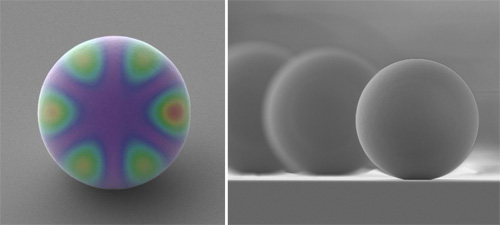
Siliziumzellen (Quelle: CSIC)
Infrarotstrahlung erfassen und transformieren
"Nach drei Jahren Arbeit hat unser Forschungsteam ein neues Konzept der Silizium-Solarzelle entwickelt, das auch die Infrarotstrahlung der Sonne erfassen und in Elektrizität umwandeln kann," erklärt der Forscher des CSIC Francisco Megueguer vom Institut für Materialwissenschaft in Madrid.
Der Forscher des CSIC und der Universitat Politètecnica de Catalunya, Moisés Garín, fügte hinzu: "Wir haben Photovoltaikzellen auf kugelförmigen Silizium-Mikrokathoden erschaffen, in denen Infrarotlicht eingeklemmt ist und sich im Inneren dreht, bis es in Elektrizität umgewandelt wird."
Diese Arbeit, an der sich auch andere Gruppen des CSIC, der Universitat Politètecnica deValència, der Universität Politèctica de Catalunya und der Universität Rovira i Virgili in Tarragona beteiligt haben, stellt einen neuen wissenschaftlichen Ansatz dar, um in Zukunft Hochleistungsvoltaikzellen entwickeln zu können.
Ref.
M. Garín, R. Phenolase, R. Alcubilla, L. Shi, L.F. Marsal und F. Meguer.All-silicon spherical-Mie-resonator photodiode with spectral response in the infrared region. Nature CommunicationsDOI:10.1038/ncomms4440
_______________________
Quelle und Bild: CSIC
Quelle
Weitere Branchennachrichten
La Universidad de Castilla-La Mancha ha acogido los días 7 y 8 de octubre una reunión de coordinación de FIREFLY, un proyecto europeo que busca electrificar parte de la cadena de valor de la industria química y reducir su dependencia de los recursos fósiles. El encuentro se celebró en la Facultad de Ciencias y Tecnologías Químicas de Ciudad Real. El...
Weitere Informationen
La Escuela Técnica Superior de Ingeniería Industrial de Barcelona, perteneciente a la Universitat Politècnica de Catalunya, celebra sus 175 años con una exposición que conecta su historia con los desafíos tecnológicos y sociales de las nuevas generaciones de ingenieros. La muestra, inaugurada el 8 de octubre, puede visitarse hasta el 17 de octubre en CASA SEAT, en Barcelona, con entrada...
Weitere Informationen
La Universidad Pontificia Comillas ha reunido a representantes institucionales, académicos y especialistas del sector tecnológico y de defensa para analizar las oportunidades y los desafíos de la inteligencia artificial en la seguridad y la defensa de España. El seminario, celebrado el 7 de octubre y difundido por la Universidad el día 9, fue organizado por la Facultad de Derecho de...
Weitere Informationen
La Universidad Politécnica de Madrid dedica este 9 de octubre una jornada a los retos de integrar el hidrógeno en la industria y el transporte, dos ámbitos en los que la reducción de emisiones exige combinar diferentes soluciones tecnológicas. La Comunidad del Hidrógeno y Pilas de Combustible de la UPM organiza el encuentro en el salón de actos de la...
Weitere Informationen
La ingeniera de telecomunicación Alicia Ramón Catalán es la ganadora del Premio Pioneras_IT 2026, promovido por el Colegio Oficial de Ingenieros de Telecomunicación y la Asociación Española de Ingenieros de Telecomunicación para visibilizar el talento femenino en el sector. La elección, anunciada el 28 de septiembre, culmina una convocatoria cuyo acto de entrega se programó para el 8 de octubre...
Weitere Informationen